

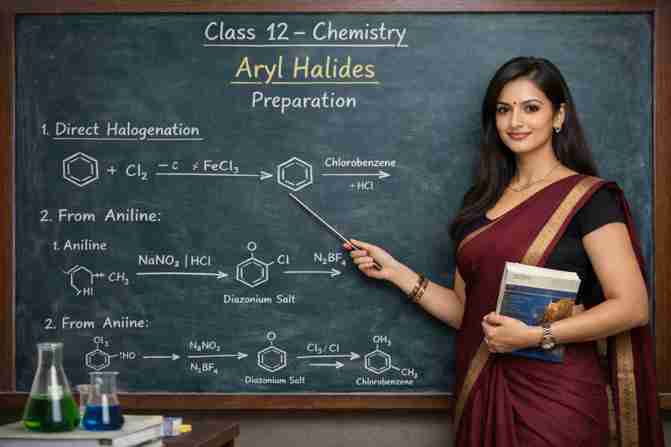
🧪 Aryl Halides Properties
Class 12 Chemistry में Aryl Halides (Haloarenes) अध्याय Organic Chemistry का एक अत्यंत महत्वपूर्ण भाग है। इस अध्याय में विशेष रूप से Aryl Halides Properties (Haloarenes की विशेषताएँ) से जुड़े प्रश्न UP Board परीक्षा में बार-बार पूछे जाते हैं।
अक्सर छात्रों से पूछा जाता है:
- Aryl halides कम reactive क्यों होते हैं?
- Halogen deactivating होते हुए भी ortho-para directing क्यों हैं?
- Aryl halides SN1 और SN2 reaction क्यों नहीं देते?
इन सभी प्रश्नों के उत्तर इस विस्तृत नोट्स में सरल भाषा में समझाए गए हैं। यह सामग्री विशेष रूप से Class 12 UP Board विद्यार्थियों के लिए तैयार की गई है और प्रस्तुत है 👉 gurugyanam.online द्वारा।
🔷 1. Aryl Halides (Haloarenes) Kya Hote Hain?
जब किसी Aromatic ring (जैसे Benzene) से Halogen (F, Cl, Br, I) जुड़ा होता है, तो ऐसे यौगिक को Aryl Halide या Haloarene कहते हैं।
सामान्य सूत्र:
Ar–X
जहाँ:
Ar = Aryl group (Benzene ring)
X = Halogen
उदाहरण:
- Chlorobenzene (C₆H₅Cl)
- Bromobenzene (C₆H₅Br)
🔷 2. Structure of Aryl Halides
- Carbon sp² hybridized होता है।
- C–X bond में partial double bond character होता है।
- Resonance effect उपस्थित होता है।
- Bond length alkyl halides से कम होती है।
इसी कारण aryl halides की properties alkyl halides से अलग होती हैं।
What is Local Business Listing
🔷 3. Physical Properties of Aryl Halides
(A) Physical State
- सामान्यतः colorless liquid या solid
- Pleasant smell
- Aryl Halides Properties
(B) Boiling Point
- Alkyl halides से अधिक
- Molecular weight के साथ बढ़ता है
- Order: Iodo > Bromo > Chloro > Fluoro
(C) Solubility
- Water में कम घुलनशील
- Organic solvents में घुलनशील
कारण: Hydrogen bonding नहीं बनता।
(D) Density
- Density halogen size के साथ बढ़ती है
- Iodobenzene की density अधिक होती है
- Aryl Halides Properties
🔷 4. Chemical Properties of Aryl Halides
Aryl halides की chemical properties को दो भागों में समझा जाता है:
- Electrophilic Substitution Reactions
- Nucleophilic Substitution Reactions
🔷 5. Electrophilic Substitution Reactions
Halogen group दो प्रभाव दिखाता है:
- –I effect (Electron withdrawing)
- +R effect (Resonance donation)
परिणाम:
- Halogen deactivating group है
- लेकिन ortho-para directing group है
- Aryl Halides Properties
Important Electrophilic Reactions:
1️⃣ Nitration
Chlorobenzene + HNO₃ → o- & p-nitrochlorobenzene
2️⃣ Sulphonation
Chlorobenzene + H₂SO₄ → Sulphonic acid derivative
3️⃣ Friedel-Crafts Alkylation
Alkyl group ring में जुड़ता है।
🔷 6. Nucleophilic Substitution Reactions
Aryl halides सामान्य परिस्थितियों में SN1 और SN2 reaction नहीं देते।
कारण:
- Carbocation unstable होता है
- Backside attack संभव नहीं
- C–X bond में partial double bond character
🔷 7. Special Case – Dow’s Process
Chlorobenzene + NaOH
High temperature (623K) और high pressure
→ Sodium phenoxide → Phenol
यह reaction कठोर परिस्थितियों में संभव है।
🔷 8. Reactivity Order in Aryl Halides
Leaving group ability:
I > Br > Cl > F
लेकिन resonance effect reactivity को प्रभावित करता है।
Aryl Halides Properties
🔷 9. Comparison: Aryl Halides vs Alkyl Halides
| Property | Alkyl Halides | Aryl Halides |
| Carbon hybridization | sp³ | sp² |
| Resonance | Absent | Present |
| SN1/SN2 | Possible | Difficult |
| Reactivity | Higher | Lower |
🔷 10. Resonance Effect (Exam Important)
Halogen lone pair benzene ring में delocalize होता है।
Result:
- C–X bond मजबूत
- Reactivity कम
- Aryl Halides Properties
🔷 11. Reasoning Based Questions
Q: Aryl halides SN1 reaction क्यों नहीं देते?
Ans: Carbocation resonance stabilized नहीं होता।
Q: Halogen deactivating होते हुए भी ortho-para directing क्यों है?
Ans: +R effect के कारण।
🔷 12. Environmental Impact
DDT
- Insecticide
- Bioaccumulation
PCB
- Industrial use
- Toxic effect
🔷 13. Important Board Exam Points
- –I और +R effect समझें
- SN1/SN2 न होने का कारण याद रखें
- Dow’s process याद रखें
- Electrophilic substitution products याद रखें
🔷 14. Short Revision Notes
- Aryl halides कम reactive होते हैं
- C–X bond मजबूत होता है
- Halogen deactivating but ortho-para directing है
- Nucleophilic substitution कठिन है
- Aryl Halides Properties
📝 Conclusion
Class 12 Chemistry में Aryl Halides Properties (Haloarenes की विशेषताएँ) अध्याय concept आधारित और reasoning से भरा हुआ है। यदि विद्यार्थी resonance effect, –I और +R effect, electrophilic substitution और nucleophilic substitution के अंतर को समझ ले, तो बोर्ड परीक्षा में उच्च अंक प्राप्त कर सकता है।
अधिक विस्तृत नोट्स और परीक्षा तैयारी सामग्री के लिए विजिट करें 👉 gurugyanam.online
❓ 25 Important FAQs with Answers Aryl Halides Properties
Q1. Aryl halide क्या है?
Ans. Aromatic ring से halogen जुड़ा हो।
Q2. सामान्य सूत्र क्या है?
Ans. Ar–X
Q3. C–X bond मजबूत क्यों है?
Ans. Resonance के कारण।
Q4. Aryl halides कम reactive क्यों हैं?
Ans. Partial double bond character।
Q5. SN1 reaction क्यों नहीं होता?
Ans. Carbocation unstable।
Q6. SN2 reaction क्यों नहीं होता?
Ans. Backside attack संभव नहीं।
Q7. Halogen किस प्रकार का group है?
Ans. Deactivating but ortho-para directing।
Q8. –I effect क्या है?
Ans. Electron withdrawing effect।
Q9. +R effect क्या है?
Ans. Resonance donation।
Q10. Nitration में क्या बनता है?
Ans. o- और p-nitrochlorobenzene।
Q11. Dow’s process क्या है?
Ans. Chlorobenzene से phenol बनाना।
Q12. Boiling point क्यों अधिक है?
Ans. High molecular weight।
Q13. Water में कम घुलनशील क्यों?
Ans. Hydrogen bonding नहीं।
Q14. Density किससे बढ़ती है?
Ans. Halogen size।
QQ15. Friedel-Crafts reaction क्या है?
Ans. Alkylation या acylation।
Q16. Carbocation unstable क्यों है?
Ans. Aromatic ring disturb होती है।
Q17. Electrophilic substitution क्या है?
Ans. Electrophile द्वारा substitution।
Q18. Ortho position क्या है?
Ans. Adjacent carbon।
Q19. Para position क्या है?
Ans. Opposite carbon।
Q20. Iodo derivative अधिक reactive क्यों?
Ans. Weak C–I bond।
Q21. Resonance क्या है?
Ans. Electron delocalization।
Q22. Aryl halide का उपयोग कहाँ?
Ans. Insecticide, solvent।
Q23. PCB क्या है?
Ans. Polychlorinated biphenyl।
Q24. Board exam में सबसे महत्वपूर्ण क्या है?
Ans. Reasoning questions।
Q25. Haloarenes और haloalkanes में मुख्य अंतर क्या है?
Ans. Resonance और reactivity।
📚 Class 12 UP Board Chemistry की पूरी तैयारी के लिए विजिट करें
आपकी सफलता ही हमारा लक्ष्य है। 🎯