
Class 12 Chemistry के एक बहुत महत्वपूर्ण और scoring chapter – Solutions (विलयन) को पढ़ेंगे।
UP Board परीक्षा में इस chapter से numericals (4–5 marks), short answers, definitions और MCQs नियमित रूप से पूछे जाते हैं।
1. Solution (विलयन) की परिभाषा
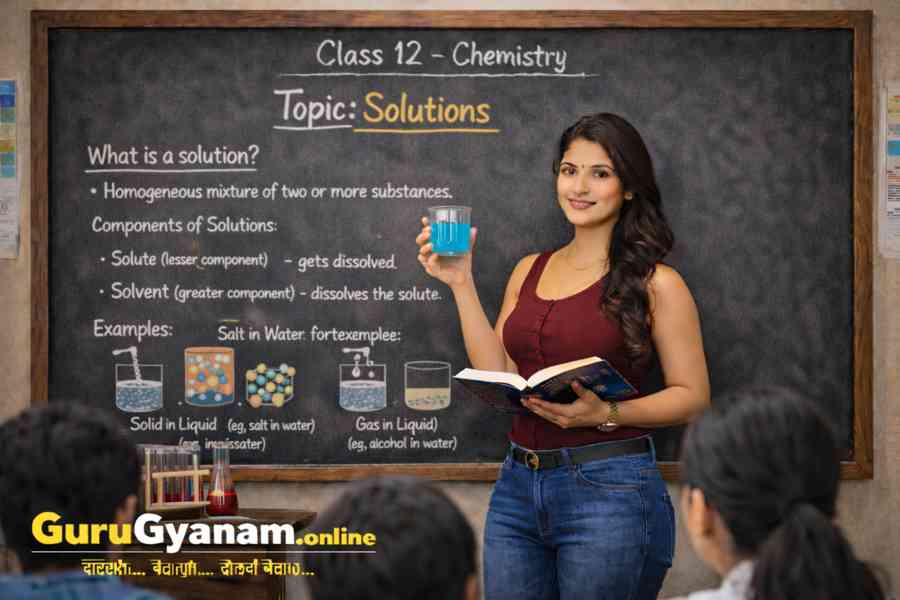
जब दो या दो से अधिक पदार्थ समरूप (homogeneous) रूप में मिल जाते हैं, तो बने मिश्रण को Solution (विलयन) कहते हैं।
👉 Solution = Solute + Solvent
- Solute: जो कम मात्रा में हो
- Solvent: जो अधिक मात्रा में हो
Example: Sugar + Water → Sugar solution
2. Solutions के प्रकार (Types of Solutions)
(A) Physical State के आधार पर
| Solute | Solvent | Example |
| Solid | Liquid | Salt in water |
| Liquid | Liquid | Alcohol in water |
| Gas | Liquid | CO₂ in water |
| Gas | Gas | Air |
(B) Concentration के आधार पर
- Dilute solution
- Concentrated solution
- Unsaturated solution
- Saturated solution
- Supersaturated solution
3. Concentration of Solutions (विलयन की सांद्रता)
Concentration बताती है कि solution में solute कितनी मात्रा में उपस्थित है।
महत्वपूर्ण Terms (Exam Oriented):
- Mass Percentage (w/w%)
- Volume Percentage (v/v%)
- Molarity (M)
- Molality (m)
- Mole Fraction (X)
4. Molarity (M)
[
\text{Molarity} = \frac{\text{Moles of solute}}{\text{Volume of solution (L)}}
]
👉 Temperature पर depend करती है।
5. Molality (m)
[
\text{Molality} = \frac{\text{Moles of solute}}{\text{Mass of solvent (kg)}}
]
👉 Temperature से independent होती है।
6. Solubility (विलेयता)
किसी निश्चित तापमान पर solvent में घुलने वाली solute की अधिकतम मात्रा को Solubility कहते हैं।
👉 Temperature बढ़ाने पर:
- Solid की solubility ↑
- Gas की solubility ↓
7. Henry’s Law (गैसों की विलेयता)
किसी द्रव में गैस की solubility, उस गैस के pressure के समानुपाती होती है।
[
p = K_H x
]
8. Raoult’s Law (वाष्प दाब नियम)
Ideal solutions में, किसी component का partial vapour pressure उसके mole fraction के समानुपाती होता है।
[
p_A = x_A p_A^0
]
9. Ideal और Non-Ideal Solutions
Ideal Solutions
- Raoult’s law obey करते हैं
- No heat change on mixing
- Example: Benzene + Toluene
Non-Ideal Solutions
- Raoult’s law obey नहीं करते
- Heat change होता है
- Example: Alcohol + Water
10. Colligative Properties (सहसंयोजी गुण)
ये गुण केवल solute के particles की संख्या पर depend करते हैं, न कि उनकी nature पर।
चार मुख्य Colligative Properties:
- Relative lowering of vapour pressure
- Elevation in boiling point
- Depression in freezing point
- Osmotic pressure
UP Board Exam Importance
✔ Numericals (molarity, molality, colligative properties)
✔ Definitions
✔ Laws (Henry, Raoult)
✔ Short & long answers
Q1. Solution क्या होता है?
Ans. दो या अधिक पदार्थों का homogeneous मिश्रण।
Q2. Solute किसे कहते हैं?
Ans. जो कम मात्रा में उपस्थित हो।
Q3. Solvent किसे कहते हैं?
Ans. जो अधिक मात्रा में उपस्थित हो।
Q4. Saturated solution क्या है?
Ans. जिसमें और solute नहीं घुल सकता।
Q5. Supersaturated solution क्या है?
Ans. Saturated से अधिक solute वाला solution।
Q6. Concentration क्या दर्शाती है?
Ans. Solute की मात्रा।
Q7. Molarity का सूत्र लिखिए।
Ans. M = moles of solute / volume (L)
Q8. Molality का सूत्र लिखिए।
Ans. m = moles of solute / mass of solvent (kg)
Q9. Molarity temperature पर depend क्यों करती है?
Ans. Volume बदलने के कारण।
Q10. Molality temperature से independent क्यों है?
Ans. Mass नहीं बदलता।
Q11. Solubility क्या है?
Ans. Solvent में घुलने वाली अधिकतम मात्रा।
Q12. Temperature बढ़ाने पर gas की solubility क्यों घटती है?
Ans. Kinetic energy बढ़ने के कारण।
Q13. Henry’s law क्या बताता है?
Ans. Gas की solubility ∝ pressure
Q14. Raoult’s law क्या है?
Ans. Vapour pressure ∝ mole fraction
Q15. Ideal solution क्या होता है?
Ans. जो Raoult’s law obey करे।
Q16. Non-ideal solution क्या होता है?
Ans. जो Raoult’s law obey न करे।
Q17. Colligative properties क्या हैं?
Ans. Particles की संख्या पर निर्भर गुण।
Q18. Colligative properties कितनी होती हैं?
Ans. चार।
Q19. Boiling point elevation क्या है?
Ans. Solute मिलाने से boiling point बढ़ना।
Q20. Freezing point depression क्या है?
Ans. Solute मिलाने से freezing point कम होना।
Q21. Osmotic pressure क्या है?
Ans. Semi-permeable membrane के कारण उत्पन्न दाब।
Q22. Mole fraction क्या है?
Ans. Component के moles / total moles
Q23. Air किस प्रकार का solution है?
Ans. Gas in gas solution।
Q24. Alcohol और water किस प्रकार का solution बनाते हैं?
Ans. Non-ideal solution।
Q25. Board exam में Solutions chapter क्यों important है?
Ans. Numericals और theory दोनों से प्रश्न आते हैं।
Teacher’s Final Advice