

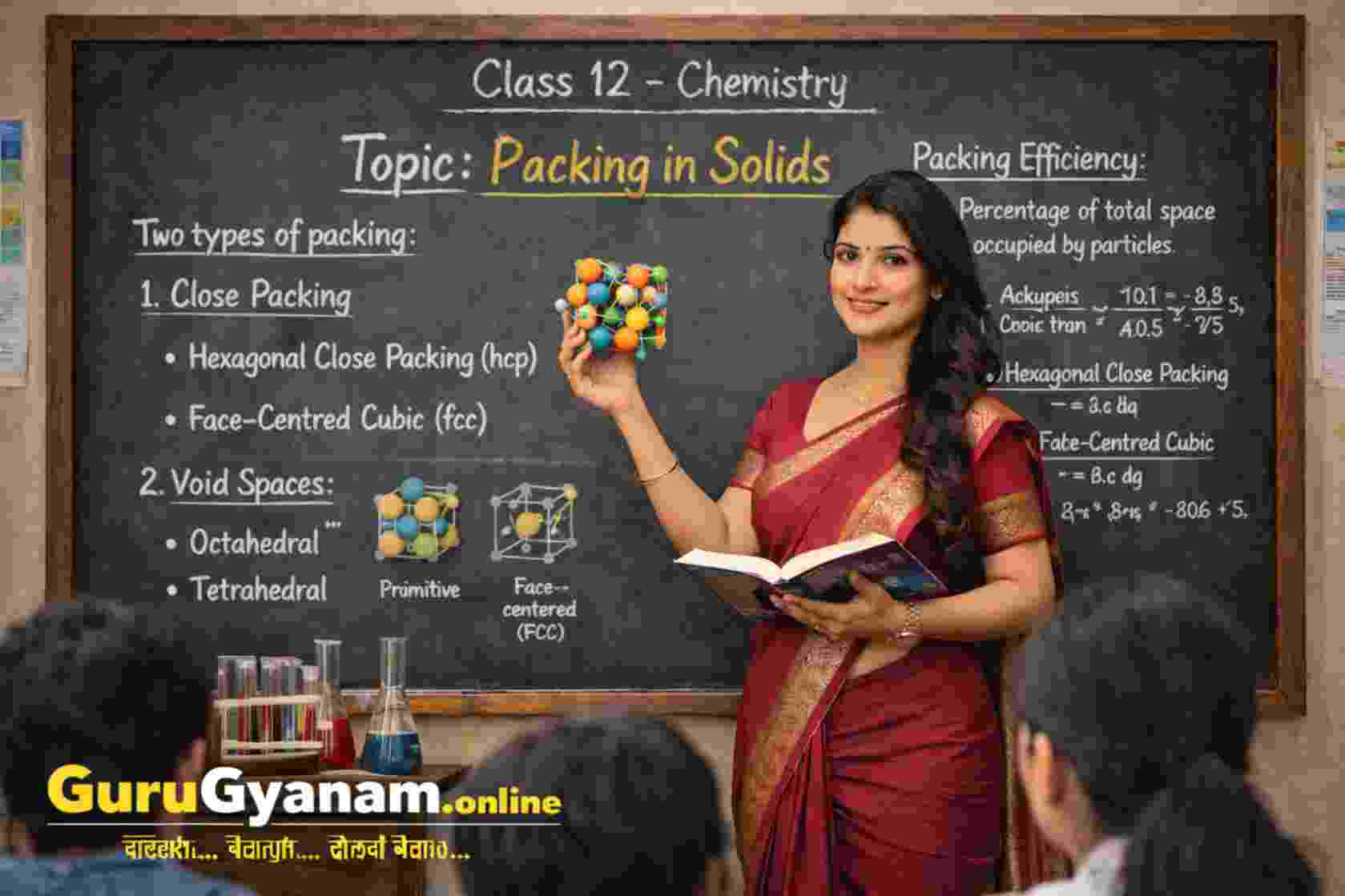
Solid State chapter के एक बहुत ही important और scoring topic – Packing in Solids (ठोसों में पैकिंग) को पढ़ेंगे।
UP Board परीक्षा में इससे MCQs, numericals, one-line और short answer questions सीधे पूछे जाते हैं।
1. Packing in Solids क्या है?
जब ठोस अवस्था में atoms या ions को hard spheres मानकर किसी निश्चित व्यवस्था में रखा जाता है, तो उसे Packing in Solids कहते हैं।
👉 Packing से हमें यह समझ आता है कि:
- atoms कितने पास हैं
- खाली जगह (voids) कितनी है
- density और stability कैसी होगी
2. Hard Sphere Model
इस model में atoms को ठोस गोल गेंद (solid spheres) माना जाता है जो आपस में touch करते हैं।
👉 यह model packing efficiency और coordination number समझने में मदद करता है।
3. Cubic Packing के प्रकार (Types of Packing in Solids)
(A) Simple Cubic Packing (SC)
- Spheres केवल corners पर touch करती हैं
- Packing loose होती है
- Stability कम होती है
Key Points:
- Atoms per unit cell = 1
- Coordination number = 6
- Packing efficiency = 52.4%
(B) Body Centered Cubic Packing (BCC)
- Corners + एक sphere body center पर
- Packing SC से बेहतर
Key Points:
- Atoms per unit cell = 2
- Coordination number = 8
- Packing efficiency = 68%
(C) Face Centered Cubic Packing (FCC)
- Corners + faces के center पर spheres
- सबसे dense और stable packing
Key Points:
- Atoms per unit cell = 4
- Coordination number = 12
- Packing efficiency = 74% (maximum)
👉 Exam Line: FCC has the highest packing efficiency.
4. Packing Efficiency (पैकिंग दक्षता)
Packing efficiency बताती है कि unit cell के कुल आयतन में से कितना भाग spheres द्वारा भरा गया है।
[
\text{Packing Efficiency} = \frac{\text{Volume occupied by atoms}}{\text{Total volume of unit cell}} \times 100
]
5. Packing Efficiency का तुलनात्मक अध्ययन
| Packing Type | Packing Efficiency |
| Simple Cubic | 52.4% |
| BCC | 68% |
| FCC | 74% |
6. Coordination Number (CN)
Coordination number = एक atom के निकटतम पड़ोसी atoms की संख्या।
| Packing | Coordination Number |
| SC | 6 |
| BCC | 8 |
| FCC | 12 |
7. Packing और Density का संबंध
👉 Packing efficiency जितनी अधिक होगी,
✔ density उतनी अधिक
✔ structure उतना stable
इसीलिए अधिकांश metals FCC या BCC structure में पाए जाते हैं।
8. Packing in Solids – Exam Importance (UP Board)
✔ MCQs (maximum packing, CN)
✔ Numericals (density based)
✔ One-liner questions
✔ Conceptual questions
Q1. Packing in solids क्या है?
Ans. Atoms की arrangement को packing कहते हैं।
Q2. Packing समझने के लिए कौन–सा model उपयोग किया जाता है?
Ans. Hard sphere model।
Q3. Simple cubic packing में atoms कहाँ होते हैं?
Ans. केवल corners पर।
Q4. SC packing में atoms per unit cell कितने होते हैं?
Ans. 1 atom।
Q5. SC packing की packing efficiency कितनी होती है?
Ans. 52.4%।
Q6. BCC packing में atoms कहाँ होते हैं?
Ans. Corners और body center पर।
Q7. BCC में atoms per unit cell कितने होते हैं?
Ans. 2 atoms।
Q8. BCC packing की packing efficiency कितनी होती है?
Ans. 68%।
Q9. FCC packing में atoms कहाँ होते हैं?
Ans. Corners और faces के center पर।
Q10. FCC में atoms per unit cell कितने होते हैं?
Ans. 4 atoms।
Q11. FCC packing की packing efficiency कितनी होती है?
Ans. 74%।
Q12. Maximum packing efficiency किसमें होती है?
Ans. FCC packing में।
Q13. Coordination number क्या होता है?
Ans. निकटतम पड़ोसी atoms की संख्या।
Q14. SC का coordination number कितना है?
Ans. 6।
Q15. BCC का coordination number कितना है?
Ans. 8।
Q16. FCC का coordination number कितना है?
Ans. 12।
Q17. Packing efficiency क्यों महत्वपूर्ण है?
Ans. Density और stability बताने के लिए।
Q18. सबसे loose packing कौन–सी है?
Ans. Simple cubic packing।
Q19. सबसे dense packing कौन–सी है?
Ans. Face centered cubic packing।
Q20. Packing और density में क्या संबंध है?
Ans. Packing बढ़ने पर density बढ़ती है।
Q21. Metals सामान्यतः कौन–सी packing अपनाते हैं?
Ans. FCC या BCC।
Q22. Packing में voids क्यों बनते हैं?
Ans. Spheres perfectly fill नहीं कर पाते।
Q23. Packing efficiency का सूत्र क्या है?
Ans. (Occupied volume / Total volume) × 100
Q24. FCC structure अधिक stable क्यों होता है?
Ans. Highest packing efficiency के कारण।
Q25. Board exam में packing in solids क्यों important है?
Ans. MCQs और numericals नियमित पूछे जाते हैं।
Teacher’s Final Advice