
आज हम Coordination Chemistry के सबसे important topic — Ligands — को deep level पर समझेंगे।
अगर Coordination Compounds chapter एक “team” है, तो ligand उस team के players हैं और central metal उसका captain 🙂
Board exam में इस topic से अक्सर questions आते हैं:
✅ लिगैंड की definition
✅ Types of ligands
✅ Denticity
✅ Chelation
✅ Ambidentate ligand
✅ Difference questions
और अच्छी बात?
👉 Once ligand concept clear हो गया — पूरा coordination chapter आसान लगने लगता है!
Instant Jobs From Home ( घर बैठे तुरंत शुरू होने वाली जॉब्स )
Easy Jobs to Make Money Online (घर बैठे आसान ऑनलाइन जॉब्स)
तो चलिए शुरू करते हैं classroom style में।
🔥लिगैंड क्या होता है? (What is a Ligand?)
Definition:
लिगैंड वह ion या molecule होता है जो central metal atom/ion को electron pair donate करके coordinate bond बनाता है।
👉 Simple English:
A ligand is an electron pair donor.
👉 Simple Hindi:
लिगैंड वह species है जो metal को electron देकर उससे जुड़ती है।
🧠 Easy Analogy (Exam Memory Trick)
Imagine metal is a teacher 🤓
Ligands are students holding notebooks (electron pairs).
Teacher accepts notebooks → Bond formed 😄
👉 इसलिए ligands को कहा जाता है:
⭐ Lewis Base (electron donor)
⚡ Ligands in a Coordination Compound
Example:
👉 [Cu(NH₃)₄]²⁺
✔ Central metal → Cu²⁺
✔ Ligand → NH₃
NH₃ nitrogen के lone pair से copper को electron देता है।
👉 Result → Coordinate bond.
🌟 Why Ligands Are So Important?
Without ligands…
❌ Coordination compounds exist नहीं करेंगे
❌ Geometry predictable नहीं होगी
❌ Color नहीं होगा
❌ Magnetism change नहीं होगा
👉 Ligands decide EVERYTHING!
Teacher Tip ⭐
“लिगैंड control the personality of metal.”
🧬 Characteristics of Ligands
A good ligand usually has:
✅ Lone pair electrons
✅ Negative charge OR high electron density
✅ Ability to form coordinate bond
Common donor atoms:
- Nitrogen
- Oxygen
- Sulfur
- Chlorine
🎯 (लिगैंड के प्रकार)
यह section बोर्ड exam का favorite है!
Ligands classify होते हैं based on:
👉 Charge
👉 Denticity
👉 Donor atoms
👉 Mode of attachment
हम सबको detail में समझेंगे।
✅ Classification Based on Charge
1️⃣ Neutral Ligands (No charge)
Examples:
✔ NH₃ (ammine)
✔ H₂O (aqua)
✔ CO (carbonyl)
👉 Even without charge — donate electron pair!
2️⃣ Negative Ligands (Anionic)
Examples:
✔ Cl⁻ (chloro)
✔ CN⁻ (cyano)
✔ OH⁻ (hydroxo)
👉 Strong bonding tendency.
3️⃣ Positive Ligands (Rare but possible)
Example:
✔ NO⁺ (nitrosonium)
Exam Note ⭐
Positive ligands rare होते हैं — but important!
🔥 Denticity – Most Important Concept
Denticity = Number of donor atoms through which ligand attaches to metal.
👉 Think of it as “number of teeth” 😄
(Dent = tooth)
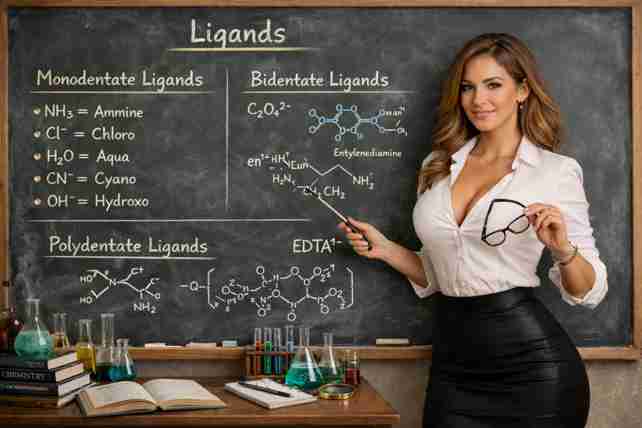
🦷 Monodentate Ligands (One Tooth)
Donate only ONE electron pair.
Examples:
✔ NH₃
✔ Cl⁻
✔ H₂O
👉 Form one coordinate bond.
Example:
[Co(NH₃)₆]³⁺
Here → six monodentate ligands.
🦷🦷 Bidentate Ligands (Two Teeth)
Donate TWO electron pairs.
Example:
✔ Ethylenediamine (en)
Structure allows it to bind at two sites.
👉 Forms ring structure.
🦷🦷🦷 Polydentate लिगैंड
Multiple donor atoms.
Example:
✔ EDTA (6 donor atoms!)
👉 Called hexadentate ligand.
Teacher Trick ⭐
More denticity = More stability.
🔗 Chelation and Chelate Effect
जब polydentate ligand metal को पकड़कर ring बनाता है:
👉 It is called Chelation.
Complex formed = Chelate.
Why Chelates Are Extra Stable?
Because:
✔ Ring structure stronger
✔ Harder to break
✔ Entropy increases
👉 Stability ↑↑
🌍 Real-Life Example
EDTA used in:
✔ Lead poisoning treatment
✔ Water hardness removal
✔ Shampoo formulations
👉 Chemistry in daily life!
💡 Ambidentate Ligands
Super important for exams 🚨
Definition:
Ligand that can attach through TWO different donor atoms — but one at a time.
Examples:
✔ NO₂⁻
✔ SCN⁻
✔ CN⁻
📚 ऐसे ही exam-focused notes के लिए visit करें:
👉 gurugyanam.onlineStudy smart. Become unstoppable. 🚀
Linkage Isomerism
Because ambidentate ligands attach differently → different compounds form.
Example:
👉 Nitro (N bonded)
👉 Nitrito (O bonded)
👉 Same formula — different structure!
Board loves this question 😄
🌈 Strong vs Weak लिगैंड
Ligands affect splitting of d-orbitals.
Strong Field लिगैंड
✔ CN⁻
✔ CO
✔ en
👉 Cause electron pairing
👉 Low spin complex.
Weak Field Ligands:
✔ H₂O
✔ F⁻
✔ Cl⁻
👉 No pairing
👉 High spin complex.
Memory Trick ⭐
“CO and CN are Champions.”
🎓 Ligands and Coordination Number
Coordination number depends on ligand denticity.
Example:
6 monodentate → CN = 6
3 bidentate → CN = 6
👉 Same CN — different लिगैंड!
⚙ Role of लिगैंड in Geometry
Ligands determine shape.
| CN | Geometry |
| 2 | Linear |
| 4 | Tetrahedral / Square planar |
| 6 | Octahedral |
Example:
[Ni(CN)₄]²⁻ → Square planar.
🎨 लिगैंड and Color
Why complexes colorful?
👉 लिगैंड cause d-orbital splitting.
Electron absorbs light → color appears.
Change लिगैंड → change color!
Example:
Cu²⁺ + H₂O → Blue
Cu²⁺ + NH₃ → Deep blue
Magic 😄
🧲 Ligands and Magnetism
Strong लिगैंड → paired electrons → diamagnetic.
Weak लिगैंड → unpaired → paramagnetic.
Exam Favorite ⭐
⚠ Common Mistakes Students Make
❌ Denticity vs coordination number confuse करना
❌ Ambidentate भूल जाना
❌ Strong vs weak mix करना
Avoid these — score higher!
🏆 Board Exam Strategy
Want easy marks?
Focus on:
✅ Definitions
✅ Types
✅ Examples
✅ Chelation
✅ Ambidentate
Practice naming!
🧠 Quick Revision Table
| Ligand Type | Example |
| Neutral | NH₃ |
| Negative | Cl⁻ |
| Monodentate | H₂O |
| Bidentate | en |
| Polydentate | EDTA |
| Ambidentate | NO₂⁻ |
Revise before exam → Confidence ↑
🌍 Applications of लिगैंड
Medicine:
✔ EDTA therapy
✔ Anti-cancer drugs
Agriculture:
✔ Micronutrient fertilizers
Industry:
✔ Catalysts
✔ Metal extraction
Biology:
✔ Hemoglobin
✔ Chlorophyll
Ligands are everywhere!
⭐ Most Expected Board Questions
👉 Define लिगैंड
👉 Types of लिगैंडs.
👉 What is denticity?
👉 Explain chelation.
👉 Ambidentate ligand example.
Prepare these → Guaranteed marks.
❓ Top 20 FAQs – (लिगैंड) –
Q1. लिगैंड क्या होता है?
Ans. Electron pair donor species.
Q2. लिगैंड Lewis acid है या base?
Ans. Lewis base.
Q3. Monodentate ligand example?
Ans. NH₃.
Q4. Bidentate example?
Ans. Ethylenediamine.
Q5. Polydentate example?
Ans. EDTA.
Q6. Denticity क्या है?
Ans. Number of donor atoms.
Q7. Chelate क्या है?
Ans. Ring complex.
Q8. Chelate effect क्या है?
Ans. Higher stability.
Q9. Ambidentate ligand?
Ans. Attach via two atoms.
Q10. Example?
Ans. NO₂⁻.
Q11. Strong लिगैंड?
Ans. CN⁻.
Q12. Weakलिगैंड?
Ans. H₂O.
Q13. Neutral लिगैंड?
Ans. CO.
Q14. Negativeलिगैंड?
Ans. Cl⁻.
Q15. लिगैंड geometry affect करते हैं?
Ans. Yes!
Q16. Color change क्यों?
Ans. d-orbital splitting.
Q17. Magnetism कौन control करता है?
Ans. लिगैंड.
Q18. EDTA denticity?
Ans.6
Q19. Coordination number depend करता है?
Ans. Donor atoms.
Q20. Board exam में important?
Ans. VERY HIGH.
🏁 Final Teacher Advice
Ligands chapter को अगर आपने deeply समझ लिया — तो पूरा coordination chemistry आपके control में आ जाएगा।
👉 Memorize मत करें — visualize करें.
👉 रोज revision करें.
👉 Examples लिखकर practice करें.
Remember:
⭐ “Concept clarity = Chemistry mastery.”
📚 ऐसे ही exam-focused notes के लिए visit करें:
👉 gurugyanam.onlineStudy smart. Become unstoppable. 🚀