

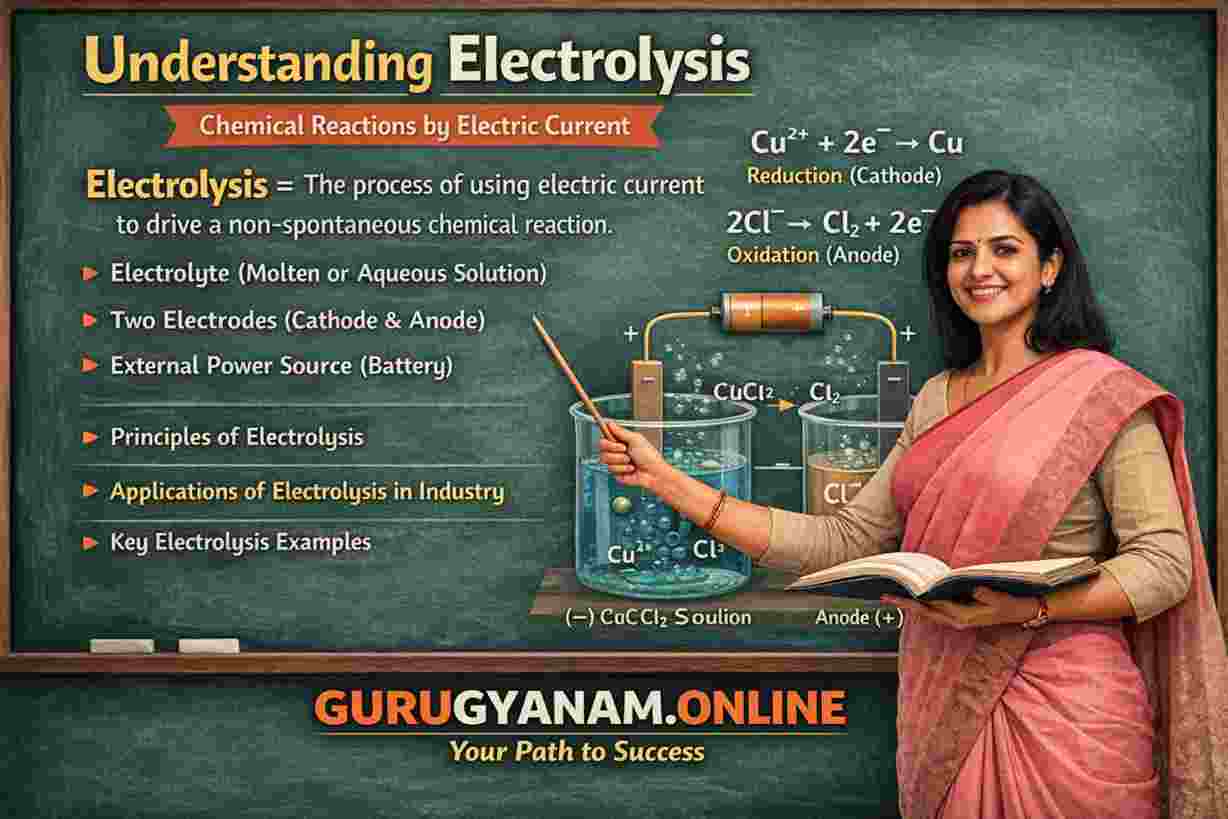
Class 12 Chemistry का Electrochemistry chapter तभी पूरी तरह समझ में आता है जब छात्र Electrolysis (विद्युत अपघटन) को अच्छे से समझ लेते हैं।
UP Board की परीक्षाओं में electrolysis से:
- परिभाषा आधारित प्रश्न
- Diagram आधारित प्रश्न
- Anode–Cathode reactions
- Faraday’s laws से numericals
लगभग हर साल पूछे जाते हैं।
👉 gurugyanam.online का उद्देश्य है कि Electrolysis को केवल रटने वाला topic न बनाकर, concept-based और life-connected बनाया जाए, ताकि छात्र exam में confident महसूस करें।
📘 Electrolysis क्या है?
विद्युत अपघटन वह प्रक्रिया है जिसमें:
- विद्युत ऊर्जा (Electrical energy) की सहायता से
- किसी रासायनिक यौगिक (compound) का
- अपघटन (decomposition) किया जाता है।
📌 परिभाषा:
“जब किसी molten या aqueous electrolyte में विद्युत धारा प्रवाहित कर उसके यौगिक को तोड़ा जाता है, तो इस प्रक्रिया को Electrolysis कहते हैं।”
🧠 सरल भाषा में समझें
अगर कोई reaction अपने आप नहीं होती,
लेकिन हम बिजली देकर उसे जबरदस्ती कराते हैं,
तो वह reaction Electrolysis के अंतर्गत आती है।
यानी:
👉 Electrical energy → Chemical change
⚙️ Electrolysis किस cell में होती है?
Electrolysis हमेशा Electrolytic Cell में होती है।
Electrolytic Cell की विशेषताएँ:
- External battery की आवश्यकता
- Reaction non-spontaneous
- Anode → Positive
- Cathode → Negative
🧪 विद्युत अपघटन के लिए आवश्यक शर्तें
1️⃣ Electrolyte
- Molten या aqueous रूप में
- Ions उत्पन्न करने में सक्षम
2️⃣ Electrodes
- Anode (Oxidation)
- Cathode (Reduction)
3️⃣ External DC Power Supply
🔄 Electrolysis में Oxidation और Reduction
Electrolysis भी एक Redox process है।
| स्थान | Process |
| Anode | Oxidation |
| Cathode | Reduction |
📌 यह rule हमेशा याद रखें – Anode पर Oxidation, Cathode पर Reduction
🧪 Types of Electrolysis (विद्युत अपघटन के प्रकार)
Class 12 syllabus में electrolysis को मुख्यतः दो भागों में समझाया जाता है:
1️⃣ Electrolysis of Molten Electrolytes
2️⃣ Electrolysis of Aqueous Solutions
1️⃣ Electrolysis of Molten Electrolytes
जब electrolyte पिघली हुई अवस्था (molten state) में होती है,
तो केवल वही ions मौजूद रहते हैं जो compound से आते हैं।
उदाहरण: Molten Sodium Chloride (NaCl)
Cathode reaction:
[
Na^+ + e^- \rightarrow Na
]
Anode reaction:
[
2Cl^- \rightarrow Cl_2 + 2e^-
]
👉 यहाँ:
- Sodium metal cathode पर
- Chlorine gas anode पर निकलती है
📌 यह example UP Board में directly पूछा जाता है।
🧠 Molten Electrolysis का Concept
- Water मौजूद नहीं होता
- कोई competition नहीं होती ions के बीच
- Reaction सरल और direct होती है
2️⃣ Electrolysis of Aqueous Solutions
Aqueous solution में:
- Solute के ions
- Water से बने H⁺ और OH⁻ ions
दोनों मौजूद होते हैं।
👉 इसलिए यहाँ Selective Discharge of Ions होता है।
🔍 Selective Discharge of Ions क्या है?
जब एक से अधिक ions मौजूद हों,
तो सभी ions discharge नहीं होते।
Discharge इस पर निर्भर करता है:
1️⃣ Discharge potential
2️⃣ Concentration of ions
3️⃣ Nature of electrode
🧪 विद्युत अपघटन of Water (महत्वपूर्ण उदाहरण)
शुद्ध पानी कमजोर conductor होता है,
इसलिए उसमें थोड़ा dilute H₂SO₄ मिलाया जाता है।
Cathode reaction:
[
2H_2O + 2e^- \rightarrow H_2 + 2OH^-
]
Anode reaction:
[
4OH^- \rightarrow O_2 + 2H_2O + 4e^-
]
👉 Gas volume ratio:
Hydrogen : Oxygen = 2 : 1
📌 यह ratio practical और theory दोनों में पूछा जाता है।
🧪 Electrolysis of Aqueous NaCl (Brine)
Cathode:
[
2H_2O + 2e^- \rightarrow H_2 + 2OH^-
]
Anode:
[
2Cl^- \rightarrow Cl_2 + 2e^-
]
👉 Products:
- Hydrogen gas
- Chlorine gas
- NaOH solution
📌 यही Chlor-alkali process का आधार है।
⚡ Faraday’s Laws of Electrolysis
Electrolysis के quantitative अध्ययन के लिए Faraday’s laws बहुत महत्वपूर्ण हैं।
🔹 Faraday’s First Law
“Electrode पर जमा पदार्थ की मात्रा, प्रवाहित विद्युत आवेश के समानुपाती होती है।”
[
m \propto Q
]
या
[
m = ZQ
]
जहाँ:
- m = Mass deposited
- Q = Charge passed
- Z = Electrochemical equivalent
🔹 Faraday’s Second Law
“समान विद्युत आवेश से जमा पदार्थों की मात्रा उनके equivalent weight के समानुपाती होती है।”
🔢 Faraday Constant
- 1 Faraday = 96500 coulomb
- 1 Faraday charge से 1 gram equivalent पदार्थ जमा होता है
📌 यह value numericals में बहुत जरूरी है।
🧮 Electrolysis Numericals – Concept
अगर current (I) और time (t) दिया हो:
[
Q = I \times t
]
और:
[
m = \frac{Q \times E}{96500}
]
👉 जहाँ E = Equivalent weight
gurugyanam.online पर numericals को इसी clear method से समझाया जाता है।
🧲 Electrolysis और Electroplating
Electrolysis का सबसे common application है Electroplating।
Electroplating में:
- Cathode → Object to be plated
- Anode → Plating metal
Uses:
- Corrosion से सुरक्षा
- Decoration
- Cost reduction
🏭 Industrial Importance of विद्युत अपघटन
Electrolysis का उपयोग कई industries में होता है:
- Aluminium extraction
- Sodium और potassium extraction
- Copper refining
- Chlor-alkali industry
- Hydrogen production
🧠 Electrolysis और Corrosion
Corrosion भी एक electrochemical process है।
Electrolysis के principles से corrosion को रोका जा सकता है:
- Galvanization
- Cathodic protection
🧪 Difference: विद्युत अपघटन vs Galvanic Cell
| बिंदु | Electrolysis | Galvanic Cell |
| Energy | Electrical → Chemical | Chemical → Electrical |
| Reaction | Non-spontaneous | Spontaneous |
| External battery | Required | Not required |
| Anode | Positive | Negative |
📌 यह table UP Board में बहुत पूछा जाता है।
✍️ Exam Oriented Tips (UP Board)
✔️ Definition बिल्कुल textbook जैसी लिखें
✔️ Anode–Cathode reactions साफ लिखें
✔️ Diagram जरूर बनाएं
✔️ Faraday’s laws शब्दशः लिखें
✔️ Numericals में unit जरूर लिखें
👉 gurugyanam.online पर UP Board pattern के अनुसार practice questions और solved numericals उपलब्ध हैं।
Q1. विद्युत अपघटन क्या है?
Ans: Electricity से compound का अपघटन।
Q2. विद्युत अपघटन किस cell में होती है?
Ans: Electrolytic cell।
Q3. विद्युत अपघटन में reaction कैसी होती है?
Ans: Non-spontaneous।
Q4. Anode पर क्या होता है?
Ans: Oxidation।
Q5. Cathode पर क्या होता है?
Ans: Reduction।
Q6. Molten NaCl के विद्युत अपघटन में क्या निकलता है?
Ans: Sodium और chlorine।
Q7. Water विद्युत अपघटन में hydrogen कहाँ निकलती है?
Ans: Cathode पर।
Q8. Water विद्युत अपघटन में oxygen कहाँ निकलती है?
Ans: Anode पर।
Q9. Water में acid क्यों मिलाया जाता है?
Ans: Conductivity बढ़ाने के लिए।
Q10. Selective discharge क्या है?
Ans: Specific ion का पहले discharge होना।
Q11. Faraday का पहला नियम क्या है?
Ans: m ∝ Q
Q12. Faraday का दूसरा नियम क्या है?
Ans: m ∝ equivalent weight
Q13. 1 Faraday कितना होता है?
Ans: 96500 coulomb।
Q14. विद्युत अपघटन से कौन-से metals निकाले जाते हैं?
Ans: Aluminium, sodium।
Q15. Electroplating विद्युत अपघटनपर आधारित क्यों है?
Ans: Electric current से metal deposition होता है।
Q16. विद्युत अपघटन किस chapter में है?
Ans: Electrochemistry।
Q17.विद्युत अपघटनमें energy conversion क्या है?
Ans: Electrical → Chemical।
Q18. Pure water conductor क्यों नहीं है?
Ans: Ions की कमी के कारण।
Q19. Brine विद्युत अपघटन का उपयोग कहाँ है?
Ans: Chlor-alkali industry।
Q20. विद्युत अपघटन practical क्यों important है?
Ans: Industry और exams दोनों में।
Q21. विद्युत अपघटन और battery में अंतर?
Ans: Reaction direction का।
Q22. विद्युत अपघटन numericals आते हैं?
Ans: हाँ, UP Board में।
Q23.विद्युत अपघटन में electrode size का प्रभाव?
Ans: Deposition rate पर।
Q24. विद्युत अपघटन क्यों जरूरी topic है?
Ans: Theory + numericals दोनों के लिए।
Q25. विद्युत अपघटन पढ़ने का best source?
Ans: gurugyanam.online