

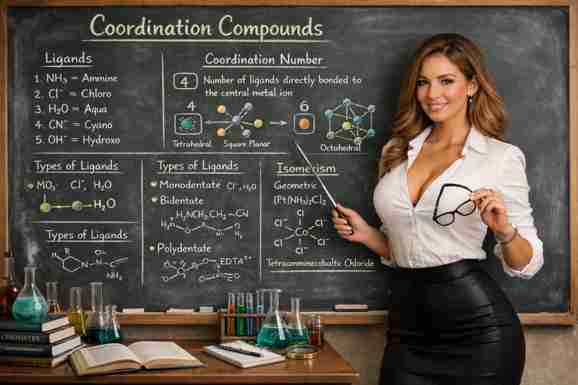
अगर आप Class 12 UP Board Chemistry की तैयारी कर रहे हैं, तो Coordination Compounds chapter बेहद important है। Board exam में इस chapter से 3–5 marks के direct questions और कई बार numerical + reasoning questions पूछे जाते हैं।
इस chapter को पढ़ते समय students अक्सर confuse हो जाते हैं क्योंकि इसमें नए terms आते हैं जैसे:
✅ Ligand
✅ Coordination number
✅ Complex ion
✅ Chelation
✅ Werner theory
✅ Isomerism
लेकिन tension लेने की जरूरत नहीं 🙂
इस guide में हम इस chapter को zero level से advanced level तक समझेंगे — बिल्कुल classroom style में।
Guaranteed Online Jobs That Actually Pay in 2026 ( घर बैठे पक्की कमाई के तरीके )
15 Powerful Work You Can Do Online to Earn Money
📘 What are Coordination Compounds? (समन्वय यौगिक क्या हैं?)
Definition (परिभाषा):
Coordination compounds वे chemical compounds होते हैं जिनमें एक central metal atom/ion कुछ molecules या ions से coordinate covalent bond के द्वारा जुड़ा होता है।
👉 Simple language में:
जब एक metal ion अपने आसपास electron pair देने वाले atoms को पकड़कर complex बनाता है — उसे coordination compound कहते हैं।
Example:
👉 [Co(NH₃)₆]Cl₃
👉 K₄[Fe(CN)₆]
यहाँ brackets के अंदर का हिस्सा coordination sphere कहलाता है।
🔥 Why Coordination Compounds Are Important?
Coordination compounds सिर्फ exam के लिए नहीं — real life में भी बहुत important हैं।
Real-Life Examples:
✔ Hemoglobin – Oxygen transport
✔ Chlorophyll – Photosynthesis
✔ Vitamin B12
✔ Catalysts
✔ Medicines
👉 यानी बिना coordination compounds के life possible नहीं!
🧠 Basic Terminology (महत्वपूर्ण शब्दावली)
1. Central Metal Atom / Ion
यह complex का heart होता है।
Example:
In [Cu(NH₃)₄]²⁺ → Copper is central metal.
2. Ligands (लिगैंड क्या होते हैं?)
Ligands वे ions या molecules होते हैं जो metal को electron pair donate करते हैं।
Types of Ligands:
✅ Monodentate Ligands (एक दाँत वाले 😄)
Only one donor atom.
Examples:
- NH₃
- H₂O
- Cl⁻
✅ Bidentate Ligands
Two donor atoms.
Example:
- Ethylenediamine (en)
✅ Polydentate Ligands
Multiple donor atoms.
Example:
- EDTA
👉 Polydentate ligands metal को tightly पकड़ते हैं — इसे Chelation कहते हैं।
Chelation Effect (Chelate Effect)
जब polydentate ligand metal को ring structure में bind करता है — complex ज्यादा stable हो जाता है।
👉 इसलिए medicines में chelating agents use होते हैं heavy metals हटाने के लिए।
🔬 Werner’s Theory (वर्नर का सिद्धांत)
Proposed by: Alfred Werner (1893)
इस theory ने पहली बार coordination compounds को scientifically explain किया।
Main Postulates:
✅ Metal has two valencies:
- Primary valency (ionizable)
- Secondary valency (non-ionizable)
✅ Secondary valency = coordination number
✅ Ligands fixed geometry में arrange होते हैं।
Example:
CoCl₃·6NH₃
Actually written as:
👉 [Co(NH₃)₆]Cl₃
- Primary valency → 3 Cl⁻
- Secondary valency → 6 NH₃
📊 Coordination Number (CN)
Metal से directly जुड़े donor atoms की संख्या।
Examples:
- [Co(NH₃)₆]³⁺ → CN = 6
- [PtCl₄]²⁻ → CN = 4
🔷 Nomenclature of Coordination Compounds (नामकरण)
IUPAC rules exam में frequently पूछे जाते हैं।
Naming Rules:
Rule 1:
Cation पहले, anion बाद में।
👉 [Co(NH₃)₆]Cl₃
Name: Hexaamminecobalt(III) chloride
Rule 2:
Ligands alphabetical order में।
ammine before chloro.
Rule 3:
Number prefixes:
| Number | Prefix |
| 2 | di |
| 3 | tri |
| 4 | tetra |
| 5 | penta |
| 6 | hexa |
Rule 4:
Negative complex → metal name ends with “ate”
Example:
Fe → Ferrate
Cu → Cuprate
👉 K₄[Fe(CN)₆]
Potassium hexacyanoferrate(II)
⚡ Bonding in Coordination Compounds
Bonding को समझने के लिए तीन theories important हैं:
ऐसे ही सरल और exam-focused Chemistry notes पढ़ने के लिए विजिट करें:
gurugyanam.online
✅ Valence Bond Theory (VBT)
✅ Crystal Field Theory (CFT)
✅ Molecular Orbital Theory (Short idea)
Valence Bond Theory (VBT)
According to VBT:
Metal orbitals hybridize → ligands donate electron pairs → bonds form.
Hybridization Examples:
| Hybridization | Geometry |
| sp³ | Tetrahedral |
| dsp² | Square planar |
| d²sp³ | Octahedral |
Inner Orbital vs Outer Orbital Complex
Inner orbital:
Uses (n-1)d orbitals
👉 Low spin
👉 More stable
Outer orbital:
Uses nd orbitals
👉 High spin
Exam tip ⭐
Magnetic behavior often asked!
🎯 Crystal Field Theory (CFT)
यह theory बताती है कि ligands electric field create करते हैं जिससे d-orbitals split हो जाते हैं।
Octahedral Splitting:
- t₂g (lower energy)
- e_g (higher energy)
Energy gap = Δ₀
Strong vs Weak Ligands
Strong Field:
- CN⁻
- CO
👉 Pairing occurs → Low spin
Weak Field:
- H₂O
- F⁻
👉 No pairing → High spin
🌈 Color in Coordination Compounds
क्यों कई complexes colorful होते हैं?
👉 Because of d-d transition
Electron lower orbital से higher orbital में jump करता है → light absorb → complementary color दिखाई देता है।
Example:
[Ti(H₂O)₆]³⁺ → Purple
🧬 Isomerism in Coordination Compounds
Very important for board exams.
Types:
1. Structural Isomerism
✔ Ionization isomerism
✔ Hydrate isomerism
✔ Linkage isomerism
Ionization Example:
[Co(NH₃)₅Br]SO₄
vs
[Co(NH₃)₅SO₄]Br
Different ions formed in solution!
2. Stereoisomerism
✔ Geometrical
✔ Optical
Geometrical Isomerism
Cis → Same side
Trans → Opposite side
Example:
Pt(NH₃)₂Cl₂
Cis form is anti-cancer drug!
Optical Isomerism
Mirror images — not superimposable.
👉 Rotate plane polarized light.
💊 Applications of Coordination Compounds
Medicine:
✔ Cisplatin – Cancer treatment
✔ Chelates – Metal poisoning
Biology:
✔ Hemoglobin
✔ Chlorophyll
Industry:
✔ Catalysts
✔ Electroplating
Analytical Chemistry:
✔ Water hardness detection (EDTA)
⭐ Exam Strategy (Board Booster)
अगर आप 90+ marks चाहते हैं तो:
✅ Nomenclature जरूर practice करें
✅ Isomerism diagrams बनाना सीखें
✅ Hybridization याद करें
✅ Strong vs weak ligands memorize करें
👉 यह chapter scoring है!
📚 Quick Revision Formula
👉 Ligand = Electron donor
👉 Metal = Electron acceptor
👉 CN = Donor atoms count
👉 Chelate = Ring formation
👉 Strong ligand → Low spin
❓ Top 20 FAQs Coordination Compounds (समन्वय यौगिक)
Q1. Coordination compound क्या है?
Metal + ligands से बना complex.
Q2. Ligand क्या होता है?
Ans. Electron pair donate करने वाला ion/molecule.
Q3. Coordination number क्या है?
Ans. Metal से जुड़े donor atoms की संख्या।
Q4. Chelate effect क्या है?
Ans. Polydentate ligand complex को stable बनाता है।
Q5. Werner theory किसने दी?
Ans. Alfred Werner.
Q6. Primary vs Secondary valency?
Ans. Primary → ionizable
Secondary → non-ionizable
Q7. Strong ligand example?
Ans. CN⁻
Q8. Weak ligand example?
Ans. H₂O
Q9. VBT full form?
Ans. Valence Bond Theory.
Q10. CFT क्या बताती है?
Ans. vd-orbital splitting.
Q11. Complex colored क्यों होते हैं?
Ans. d-d transition.
Q12. Cis-trans क्या है?
Ans. Geometrical isomerism.
Q13. Optical isomerism क्या है?
Ans. Mirror image molecules.
Q14. Hexaammine का मतलब?
Ans. Six NH₃ ligands.
Q15. Ferrate किसे कहते हैं?
Ans. Negative iron complex.
Q16. EDTA क्या है?
Ans. Polydentate chelating ligand.
Q17. Cisplatin किस काम आता है?
Ans. Cancer treatment.
Q18. Coordination sphere क्या है?
Ans. Bracket के अंदर का complex.
Q19. Hybridization क्यों जरूरी है?
Ans. Geometry predict करने के लिए।
Q20. Board exam में इस chapter का weightage?
Ans. High scoring — 3–5 marks guaranteed.
ऐसे ही सरल और exam-focused Chemistry notes पढ़ने के लिए विजिट करें:
gurugyanam.online