

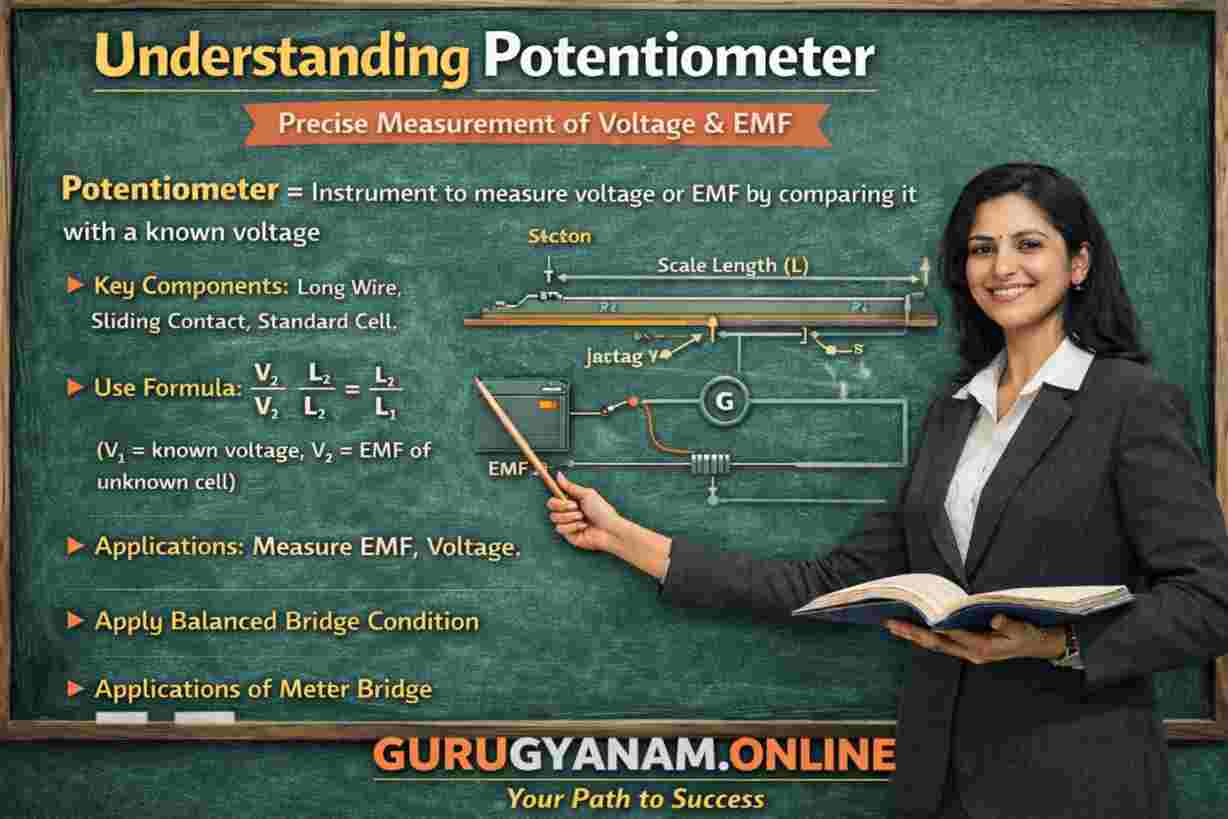
Class 12 Physics के Current Electricity अध्याय में Potentiometer एक अत्यंत महत्वपूर्ण और high-scoring topic है।
यह chapter theory के साथ-साथ numericals और practical understanding भी माँगता है, और potentiometer इसमें central role निभाता है।
UP Board की परीक्षाओं में potentiometer से:
- Definition और principle
- EMF comparison
- Internal resistance की derivation
- Numericals (3–5 marks)
- Practical-based questions
लगभग हर साल पूछे जाते हैं।
👉gurugyanam.online का उद्देश्य है कि Potentiometer को सिर्फ formulas तक सीमित न रखकर, classroom-style explanation + daily life connect के साथ समझाया जाए।
📘 Potentiometer क्या है?
Potentiometer एक ऐसा electrical instrument है जिसकी सहायता से हम:
- किसी cell का EMF माप सकते हैं
- दो cells के EMF की तुलना (comparison) कर सकते हैं
- किसी cell का internal resistance ज्ञात कर सकते हैं
📌 परिभाषा:
“Potentiometer एक ऐसा उपकरण है, जो बिना धारा लिए (without drawing current) किसी cell के EMF या potential difference को मापता है।”
🧠 सरल भाषा में समझें
Voltmeter:
- Circuit से current लेता है
- Measurement में error आ सकता है
Potentiometer:
- Zero current (null method) पर काम करता है
- इसलिए ज्यादा accurate होता है
👉 यही potentiometer की सबसे बड़ी खासियत है।
🔗 Potentiometer और Meter Bridge में अंतर
- Meter bridge → Resistance measurement
- Potentiometer → EMF / Potential difference measurement
दोनों ही null method पर आधारित होते हैं,
इसलिए accuracy ज्यादा होती है।
🔌पोटेंशियो मीटर की रचना (Construction)
Potentiometer में निम्नलिखित मुख्य भाग होते हैं:
1️⃣ Uniform resistance wire (लंबी और पतली)
2️⃣ Battery (driver cell)
3️⃣ Rheostat (current control के लिए)
4️⃣ Galvanometer
5️⃣ Jockey (sliding contact)
6️⃣ Key और connecting wires
⚙️ Potentiometer का Circuit Arrangement
- Resistance wire को wooden board पर लगाया जाता है
- Driver battery से wire में constant current बहाया जाता है
- Galvanometer और jockey के माध्यम से test cell जोड़ा जाता है
👉 Wire के किसी बिंदु पर potential match होने पर galvanometer में zero deflection मिलता है।
🧠 पोटेंशियो मीटर का Principle (सिद्धांत)
Potentiometer का सिद्धांत है:
“यदि किसी uniform wire में समान धारा प्रवाहित हो, तो wire के किसी भी भाग पर potential drop उसकी लंबाई के समानुपाती होता है।”
Mathematical Form:
[
V \propto l
]
या,
[
V = k l
]
जहाँ:
- V = Potential difference
- l = Length of wire
- k = Potential gradient
📐 Potential Gradient क्या है?
Potential Gradient (k) का अर्थ है:
“Per unit length potential drop”
[
k = \frac{V}{L}
]
📌 यह potentiometer का बहुत महत्वपूर्ण concept है।
⚖️ पोटेंशियो मीटर को Null Method क्यों कहते हैं?
जब:
- Wire पर किसी point का potential
- Cell के EMF के बराबर हो जाता है
तो:
- Galvanometer में कोई deflection नहीं होता
👉 इसी zero current condition के कारण पोटेंशियो मीटर को null method कहा जाता है।
🔋 Potentiometer से EMF की Measurement
मान लीजिए:
- Cell का EMF = E
- Balancing length = l
तो:
[
E = k l
]
👉 जहाँ k पहले से ज्ञात होता है।
🔄 Comparison of EMF of Two Cells
यह UP Board का सबसे common question है।
मान लीजिए:
- Cell-1 का EMF = E₁
- Cell-2 का EMF = E₂
- Balancing lengths = l₁ और l₂
तो:
[
\frac{E_1}{E_2} = \frac{l_1}{l_2}
]
📌 यही potentiometer का most important formula है।
🧠 Comparison Method का Advantage
- Cells से current नहीं लिया जाता
- Internal resistance का effect नहीं पड़ता
- Result ज्यादा accurate होता है
👉 Voltmeter से बेहतर method।
🔥 Potentiometer से Internal Resistance निकालना
Potentiometer की एक advanced application है
Internal Resistance (r) of a Cell निकालना।
Case-1: Open Circuit (No current)
- EMF = E
- Balancing length = l₁
Case-2: Closed Circuit (Current flowing)
- Terminal voltage = V
- Balancing length = l₂
Formula:
[
r = R \left(\frac{l_1 – l_2}{l_2}\right)
]
जहाँ:
- R = External resistance
📌 यह derivation UP Board में long question के रूप में आती है।
🧮 Potentiometer – Numerical Concept
Example:
यदि:
- l₁ = 100 cm
- l₂ = 80 cm
- R = 4 Ω
तो:
[
r = 4 \left(\frac{100 – 80}{80}\right)
]
[
r = 4 \times \frac{20}{80} = 1 , \Omega
]
👉 Step-wise solution लिखना extra marks दिलाता है।
⚠️ पोटेंशियो मीटर की Precautions
✔️ Wire uniform हो
✔️ Driver cell का EMF test cell से ज्यादा हो
✔️ Jockey को हल्के से touch करें
✔️ Rheostat से current constant रखें
✔️ Galvanometer zero adjusted हो
👉 ये points practical exams में बहुत important हैं।
🧠 Sources of Error
- Wire का non-uniform होना
- Temperature rise
- Loose connections
- Contact resistance
इनका mention करने से answer complete माना जाता है।
⚖️ पोटेंशियो मीटर बनाम Voltmeter
| बिंदु | Potentiometer | Voltmeter |
| Method | Null method | Deflection method |
| Current drawn | नहीं | हाँ |
| Accuracy | बहुत अधिक | कम |
| Internal resistance effect | नहीं | हाँ |
🏠 Daily Life में पोटेंशियो मीटर
- Calibration of voltmeters
- Sensor circuits
- Laboratory measurements
- Electronics testing
✍️ Exam Oriented Tips (UP Board)
✔️ Principle शब्दशः लिखें
✔️ Diagram neat और labelled बनाएं
✔️ EMF comparison formula जरूर लिखें
✔️ Internal resistance derivation याद रखें
✔️ Numericals में unit और steps दिखाएं
👉 gurugyanam.online पर UP Board pattern के अनुसार practice numericals, derivations और viva questions उपलब्ध हैं।
Q1. पोटेंशियो मीटर क्या है?
Ans: EMF और potential difference मापने का उपकरण।
Q2. पोटेंशियो मीटर किस chapter में है?
Ans: Current Electricity।
Q3. पोटेंशियो मीटर किस principle पर काम करता है?
Ans: Potential drop ∝ length।
Q4. पोटेंशियो मीटर null method क्यों है?
Ans: Zero current condition के कारण।
Q5.पोटेंशियो मीटरvoltmeter से बेहतर क्यों है?
Ans: ज्यादा accurate होने के कारण।
Q6. Potential gradient क्या है?
Ans: Per unit length potential drop।
Q7. EMF comparison का formula क्या है?
Ans: E₁/E₂ = l₁/l₂
Q8. पोटेंशियो मीटर से internal resistance निकाला जा सकता है?
Ans: हाँ।
Q9. Driver cell का EMF कैसा होना चाहिए?
Ans: Test cell से अधिक।
Q10. Galvanometer का role क्या है?
Ans: Null point detect करना।
Q11. Jockey क्या है?
Ans: Sliding contact।
Q12. Potentiometer practical में पूछा जाता है?
Ans: हाँ।
Q13. Potentiometer में current क्यों constant रखते हैं?
Ans: Accurate measurement के लिए।
Q14. Balancing length क्या है?
Ans: Zero deflection वाली लंबाई।
Q15. Potentiometer से voltage मापा जा सकता है?
Ans: हाँ।
Q16. पोटेंशियो मीटर और meter bridge में समानता?
Ans: दोनों null method हैं।
Q17. पोटेंशियो मीटर की accuracy क्यों ज्यादा है?
Ans: Current draw नहीं करता।
Q18. Temperature बढ़ने से क्या प्रभाव पड़ता है?
Ans: Resistance बदल सकती है।
Q19. पोटेंशियो मीटर से कौन-सी quantity सीधे नहीं मापते?
Ans: Current।
Q20. Potentiometer numericals आते हैं?
Ans: हाँ, UP Board में।
Q21. पोटेंशियो मीटर का diagram क्यों जरूरी है?
Ans: Board exams में marks मिलते हैं।
Q22. पोटेंशियो मीटर कहाँ उपयोग होता है?
Ans: Laboratories में।
Q23. पोटेंशियो मीटर का main advantage?
Ans: High accuracy।
Q24. पोटेंशियो मीटर का limitation?
Ans: Portable नहीं होता।
Q25. Potentiometer पढ़ने का best source?
Ans: gurugyanam.online










[…] Potentiometer (पोटेंशियो मीटर) Class 12 Physics – UP Board […]
[…] Potentiometer (पोटेंशियो मीटर) Class 12 Physics – UP Board […]