

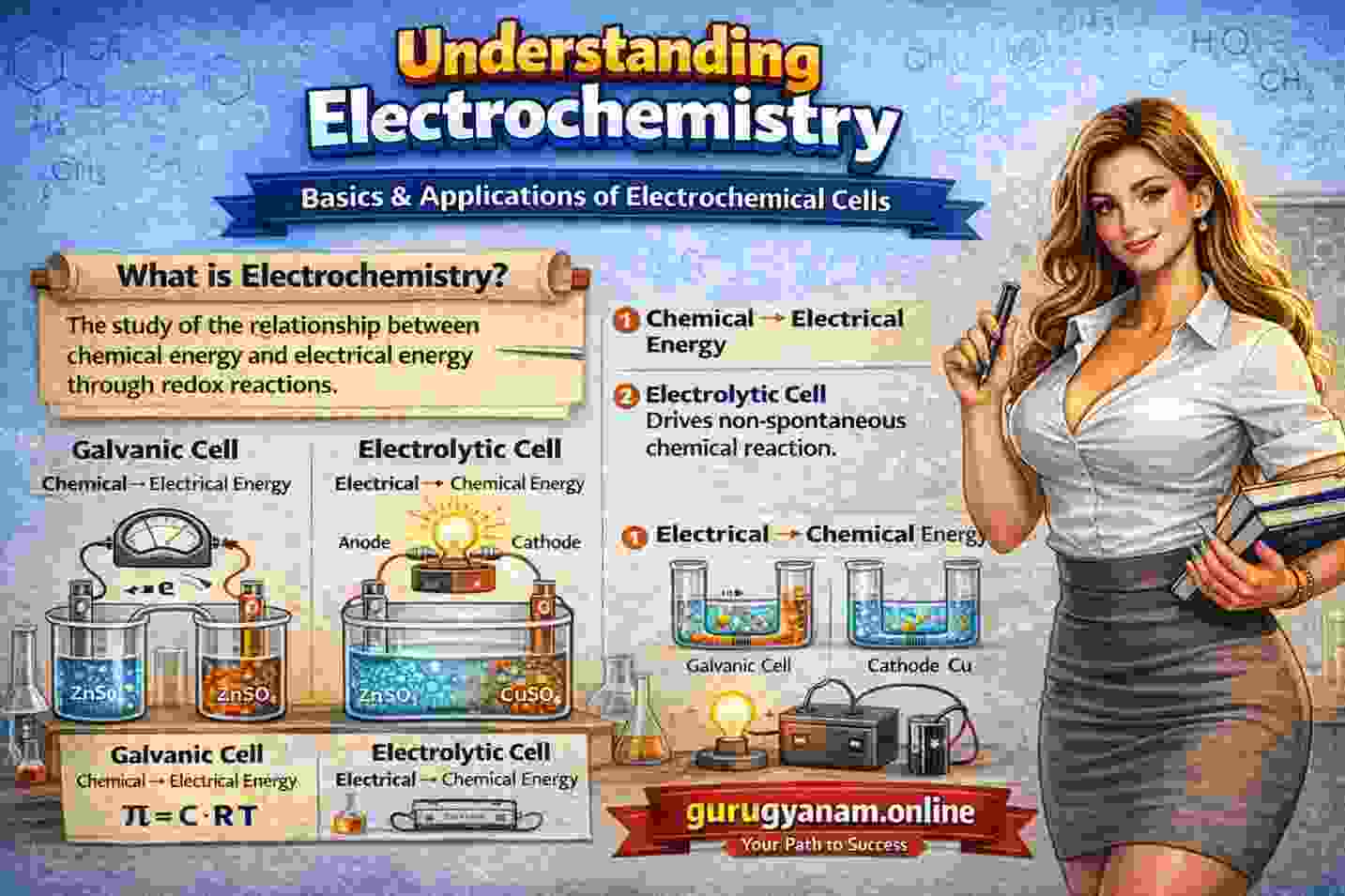
Class 12 Chemistry का Electrochemistry chapter छात्रों को अक्सर कठिन लगता है, क्योंकि इसमें chemical reactions + electricity + mathematics तीनों का मेल होता है।
लेकिन यदि concept को सही तरीके से समझ लिया जाए, तो यही chapter scoring बन जाता है।
UP Board की परीक्षाओं में Electrochemistry से:
- Definitions
- Short answers
- Numericals
- Reasoning based questions
हर साल पूछे जाते हैं।
👉gurugyanam.online का उद्देश्य है कि Electrochemistry को डराने वाला नहीं, समझने वाला topic बनाया जाए – बिल्कुल classroom teaching की तरह।
📘 Electrochemistry क्या है?
Electrochemistry रसायन विज्ञान की वह शाखा है जो:
- Electrical energy ↔ Chemical energy
के आपसी संबंध का अध्ययन करती है।
📌 सरल शब्दों में:
जब chemical reaction से बिजली बनती है
या बिजली की मदद से chemical reaction कराई जाती है,
तो यह सब Electrochemistry के अंतर्गत आता है।
🧠 Daily Life से जुड़ाव
- Mobile battery
- Car battery
- Electroplating
- Corrosion (जंग लगना)
- Electrolysis
ये सभी electrochemistry के practical examples हैं, जो हम रोज़ देखते हैं।
🔋 Electrochemical Cell क्या होता है?
Electrochemical Cell वह व्यवस्था है जिसमें:
- Redox reaction होती है
- Chemical energy → Electrical energy में बदलती है
🧪 Types of Electrochemical Cells
1️⃣ Galvanic (Voltaic) Cell
- Chemical energy → Electrical energy
- Reaction spontaneous होती है
Example:
Daniell cell
2️⃣ Electrolytic Cell
- Electrical energy → Chemical energy
- Reaction non-spontaneous होती है
Example:
Water electrolysis
⚙️ Daniell Cell (महत्वपूर्ण उदाहरण)
Daniell cell में:
- Zinc rod → Anode
- Copper rod → Cathode
Reactions:
- Oxidation (Anode):
Zn → Zn²⁺ + 2e⁻ - Reduction (Cathode):
Cu²⁺ + 2e⁻ → Cu
📌 यही redox concept Electrochemistry की foundation है।
🔄 Oxidation और Reduction
| Process | Meaning |
| Oxidation | Loss of electrons |
| Reduction | Gain of electrons |
👉 OIL RIG Rule
Oxidation Is Loss, Reduction Is Gain
🔌 Electrode और उनके प्रकार
Anode
- Oxidation होता है
- Galvanic cell में negative होता है
Cathode
- Reduction होता है
- Galvanic cell में positive होता है
⚡ EMF (Electromotive Force)
EMF cell की वह क्षमता है जो electrons को flow करने के लिए प्रेरित करती है।
Formula:
[
E^\circ_{\text{cell}} = E^\circ_{\text{cathode}} – E^\circ_{\text{anode}}
]
📌 UP Board में यह formula बहुत महत्वपूर्ण है।
📊 Standard Electrode Potential
- Standard conditions:
- 1 atm pressure
- 1 M concentration
- 298 K temperature
Hydrogen electrode को zero reference माना जाता है।
🔋 Nernst Equation
Real conditions में EMF निकालने के लिए Nernst equation का उपयोग होता है।
Formula:
[
E = E^\circ – \frac{0.059}{n} \log Q
]
जहाँ,
- (E^\circ) = Standard EMF
- (n) = electrons transferred
- (Q) = Reaction quotient
📌 Numericals में बहुत पूछा जाता है।
🔌 Electrolysis (विद्युत अपघटन)
जब किसी molten या aqueous electrolyte में:
- External current pass की जाती है
- Chemical reaction होती है
तो इसे Electrolysis कहते हैं।
⚗️ Faraday’s Laws of Electrolysis
First Law
जमा हुए पदार्थ की मात्रा ∝ Passing charge
Second Law
Different substances deposited ∝ Equivalent weight
📌 Faraday’s laws से numericals आते हैं।
🔋 Conductance और Resistance
Resistance (R)
[
R = \rho \frac{l}{A}
]
Conductance (G)
[
G = \frac{1}{R}
]
⚡ Types of Conductance
1️⃣ Specific Conductance (κ)
2️⃣ Molar Conductance (Λₘ)
[
\Lambda_m = \frac{\kappa \times 1000}{M}
]
🧠 Strong vs Weak Electrolytes
- Strong electrolytes → High conductance
- Weak electrolytes → Low conductance
Dilution पर:
- Strong → थोड़ा change
- Weak → बहुत ज्यादा increase
🔧 Electroplating (Practical Application)
Electroplating में:
- Object को cathode बनाया जाता है
- Metal ions उस पर deposit होते हैं
Uses:
- Corrosion protection
- Decoration
- Cost reduction
🧲 Corrosion (जंग लगना)
Corrosion भी एक electrochemical process है।
Example:
Iron + Oxygen + Moisture → Rust
👉 Prevention:
- Painting
- Galvanization
- Cathodic protection
✍️ Exam Oriented Tips (UP Board)
✔️ Definitions word-to-word लिखें
✔️ Cell reaction properly balance करें
✔️ Formula के साथ unit लिखें
✔️ Numericals में steps दिखाएँ
✔️ Nernst equation practice करें
gurugyanam.online पर board-pattern numericals और MCQs उपलब्ध हैं।
Q1. Electrochemistry क्या है?
Ans: Chemical और electrical energy के संबंध का अध्ययन।
Q2. Electrochemical cell क्या है?
Ans: Chemical energy को electrical energy में बदलने वाली व्यवस्था।
Q3. Galvanic cell क्या है?
Ans: Spontaneous reaction वाला cell।
Q4. Electrolytic cell क्या है?
Ans: External current से reaction कराने वाला cell।
Q5. Oxidation क्या है?
Ans: Loss of electrons।
Q6. Reduction क्या है?
Ans: Gain of electrons।
Q7. Anode पर क्या होता है?
Ans: Oxidation।
Q8. Cathode पर क्या होता है?
Ans: Reduction।
Q9. EMF क्या है?
Ans: Cell की driving force।
Q10. EMF का formula क्या है?
Ans: E°cell = E°cathode − E°anode
Q11. Nernst equation क्यों उपयोगी है?
Ans: Non-standard EMF निकालने के लिए।
Q12. Electrolysis क्या है?
Ans: Current से chemical reaction।
Q13. Faraday का पहला नियम क्या कहता है?
Ans: Deposited mass ∝ charge।
Q14. Conductance क्या है?
Ans: Current flow की क्षमता।
Q15. Molar conductance क्या है?
Ans: 1 mole electrolyte की conductance।
Q16. Strong electrolyte क्या है?
Ans: जो पूरी तरह ionize हो।
Q17. Weak electrolyte क्या है?
Ans: जो आंशिक ionize हो।
Q18. Electroplating क्यों की जाती है?
Ans: Protection और decoration के लिए।
Q19. Corrosion क्या है?
Ans: Metal का धीरे-धीरे नष्ट होना।
Q20. Daniell cell में anode कौन है?
Ans: Zinc
Q21. Daniell cell में cathode कौन है?
Ans: Copper
Q22. Hydrogen electrode potential कितना माना जाता है?
Ans: Zero
Q23. Electrochemistry किस chapter में है?
Ans: Class 12 Chemistry
Q24. UP Board में electrochemistry numericals आते हैं?
Ans: हाँ, नियमित रूप से।
Q25. Electrochemistry पढ़ने का best source?
Ans: gurugyanam.online